Call for Papers
The International Conference On Advancements In Computing (ICAC) Is Organized By The Faculty Of Computing Of Sri Lanka Institute Of Information Technology (SLIIT) As An Open Forum For Academics Along With Industry Professionals To Present The Latest Findings, Research Output And Practical Deployments In The Computer Science And Information Technology Domains. ICAC 2025 Will Be Held On 9th And 10th December For The Seventh Consecutive Year And All Previous ICAC Conferences (2019 – 2024) Were Successfully Conducted With The Technical Co-sponsorship By IEEE Sri Lanka. Uplifting The Research Culture And Elevating The Quality Of Research By Sri Lankan Researchers Being The Primary Objective, ICAC Creates A Platform For National And International Researchers To Showcase Research Output, Network, And Initiate Collaborations. In Addition, This Year’s Conference Will Explore The Transformative Potential Of Artificial Intelligence, Quantum Computing, And Emerging Technologies, Paving The Way For Groundbreaking Advancements That Will Shape The Future Of Computing.
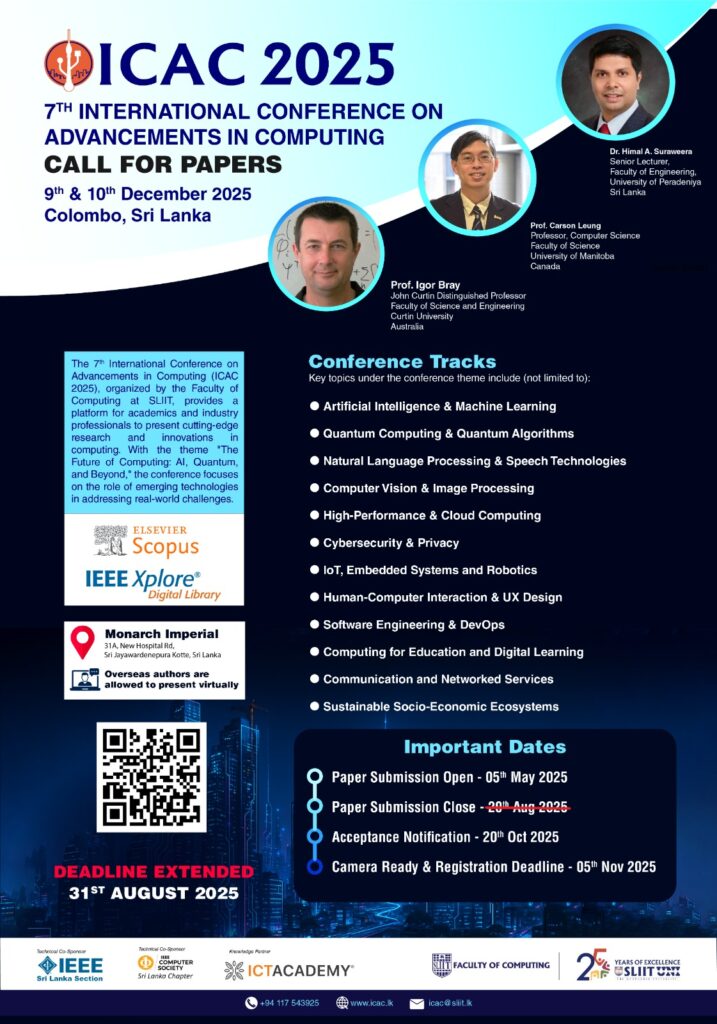
Conference Tracks
Prospective authors are kindly invited to submit manuscripts through the ICAC 2025 online portal (Conference Management Tool):
(Submission Link: https://cmt3.research.microsoft.com/7ICAC2025/Submission/Index)
Major topics under the conference theme include (not limited to):
- Quantum Computing &Quantum Algorithms –Quantum supremacy, Quantum machine learning and AI applications, Post-quantum cryptography, Quantum-safe security, Quantum algorithms for optimization, Challenges and future directions in practical quantum computing
- Artificial Intelligence & Machine Learning – Deep learning, Reinforcement learning, Generative AI, Transfer learning, Few-shot learning, Self-supervised learning, AI applications in healthcare, finance & autonomous systems, Ethics in AI, Evolution of LLMs and multimodal AI, AI-driven automation and decision-making, XAI
- Natural Language Processing & Speech Technologies – Transformers, Sentiment analysis, Conversational AI, Speech recognition, Voice synthesis advancements, Cross-lingual NLP, Low-resource language modelling
- Computer Vision & Image Processing – Object detection, Segmentation, Tracking, Facial recognition, Learning in vision systems, Autonomous vision, Multi-modal AI, Medical imaging
- High-Performance & Cloud Computing – Parallel computing architectures, GPU acceleration, Edge computing and serverless architectures, Privacy-preserving computing, AI-driven computing resource allocation and scheduling, Digital twins
- Cybersecurity & Privacy – AI-powered cybersecurity, Threat intelligence, Zero-trust security, Confidential computing, Data privacy regulations (GDPR, CCPA), Malware detection, Intrusion detection, Adversarial AI attacks, Blockchain-based security solutions, Blockchain
- IoT, Embedded Systems and Robotics – IoT applications, 5G and edge AI, Digital twins, Embedded AI, Ultra-low-power computing, Brain-computer interfaces (BCIs), AI-powered robotics, Industrial automation, Assistive robotics, Bio-inspired robot designs
- Human-Computer Interaction & UX Design – UX personalization, Neural interaction systems, Virtual reality (VR), Augmented reality (AR), Emotional AI, Affective computing
- Software Engineering & DevOps – AI in software development, Low-code and no-code platforms, DevOps automation, Software security, Vulnerability detection, Secure coding practices, Containerization, Microservices, Cloud-native development, Software verification, Software validation
- Computing for Education and Digital Learning – AI in education, E-learning Technologies, Collaborative and remote learning, Data-driven education, Ethics and accessibility in Digital learning, Personalized learning
- Communication and Networked Services – Cellular Networks Including 4G, 5G, Wireless and Mobile Networks, Network Simulations and Modelling, Routing, Switching and Protocols, Cooperative Communications and Networking, Cloud Computing, Virtualization, SDN, CDN, QOS and Resource Management
-
Sustainable Socio-Economic Ecosystems – eCommerce and Digital Marketplaces, Social Media Integration and Digital Collaboration Tools, Digital Entrepreneurship and Startup Ecosystems, Information Systems (IS) Implementation and Best Practices, Technology Infrastructure and Organizational Processes, Design and Development Methodologies for Digital Solutions, Risk Management in Digital Environments, Innovation and Knowledge Management
Important Dates
Paper Submission Guidelines
These papers should follow the standard IEEE conference format. Information regarding the formatting and other details could be obtained from the link below. All submitted papers should contain original, unpublished work. All submissions will be checked for plagiarism.
Paper submissions should satisfy the criteria listed below.
- Paper template: The paper submission template (IEEE double-column) can be found at:
Manuscript Templates for Conference Proceeding: https://www.ieee.org/conferences/publishing/templates.html
- Paper Format: Should be written using double column format in A4 (Download A4 Format from the IEEE templates) size with maximum up to 6 pages including all figures, tables, and references.
- Allowable file size: 2 MB
- Paper submission:
-
-
- Submit your paper (pdf version) through ICAC 2025 online paper submission system. (Submission Link: https://cmt3.research.microsoft.com/7ICAC2025/Submission/Index)
- The Microsoft CMT service used for managing the peer-reviewing process for this conference. This service was provided for free by Microsoft and they bore all expenses, including costs for Azure Cloud Services as well as for software development and support.
- Final submission PDF file must be IEEE Xplore compliant.
-
-
Review & Publication Process
- Desk review: Initial submissions with high similarity index will be rejected without review.
- Review: All the papers submitted to ICAC2025 are subjected to double blind review. Hence, the authors must submit the paper to CMT without the author names and their affiliations to facilitate double blind-review process.
- Camera-ready submission: Authors of accepted papers will be notified through email requesting to submit the camera-ready version.
- Registration: For each accepted paper, at least one of the authors must register on or before the registration deadline.
- Presentation: Presenting the accepted paper is mandatory for the paper to be included in IEEE Xplore® on‐line digital library. ICAC2025 may allow the foreign authors to present papers through online mode on request.
- IEEE Xplore Inclusion: The ICAC2025 accepted and presented papers will be submitted for inclusion into IEEE Xplore, subject to meeting IEEE Xplore’s scope and quality requirements.
- Awards: Outstanding papers with high impact will be selected for the Best Paper Award(s) at the conference. Conference Best Paper selection committee comprising of eminent professors will be appointed by the Technical Program Committee.
Camera-Ready Submission Guidelines
- Please check the reviewers’ comments for your paper through the Microsoft CMT system. The authors are expected to address all reviewer comments and change the paper accordingly. (Please note that you are not allowed to make major structural changes to the accepted paper).
- Paper title, author names, affiliations (including supervisor names and affiliations) must be in the correct format (refer to https://ieeeauthorcenter.ieee.org/wp-content/uploads/IEEE_Style_Manual.pdf).
- Authors can get the IEEE templates (both MS Word and LaTex templates) and instructions from https://www.ieee.org/conferences/publishing/templates
- The abstract should be limited to 150–200 words, and a maximum of 4–5 keywords should be provided along with the abstract.
- Please make sure all your references/sources are cited/referred using IEEE referencing format (refer to https://ieeeauthorcenter.ieee.org/wp-content/uploads/IEEE-Reference-Guide.pdf).
- Paper should be proof-read thoroughly. Grammar and spelling mistakes need to be addressed and corrected carefully.
- Figures and tables should be clear, readable, and the captions should follow the IEEE formatting guidelines .All figure captions are left-aligned in Times New Roman, black font, size 8, and all table captions are centered in uppercase Times New Roman, black font, size 8.(refer to https://ieeeauthorcenter.ieee.org/wp-content/uploads/IEEE_Style_Manual.pdf).
- Please include the following copyright notice in the footer (left-aligned) of the first page as shown in the IEEE templates also:
979-8-3315-6222-9/25/$31.00 ©2025 IEEE - Generate and validate your Camera-Ready PDF using IEEE PDF eXpress.
- Upload the PDF eXpress generated camera-ready file (PDF file) through the CMT system.
- Generate the IEEE Electronic Copyright Form (eCF), ensuring that the paper title and author names entered in the eCF match exactly as they appear in your final camera-ready paper.
- Upload the eCF through the CMT system.
(Click the button below to download the detailed camera-ready submission guidelines)
IEEE No-Show Policy
Please take note that IEEE has a strict policy on no-show.
Therefore, if your paper is accepted, one of the authors MUST PRESENT their paper at the conference.
Papers with no-show participants will not be published in IEEEXplore.
Moreover, no refund of the conference fees may be claimed by the no-show author.