Preconference Workshops
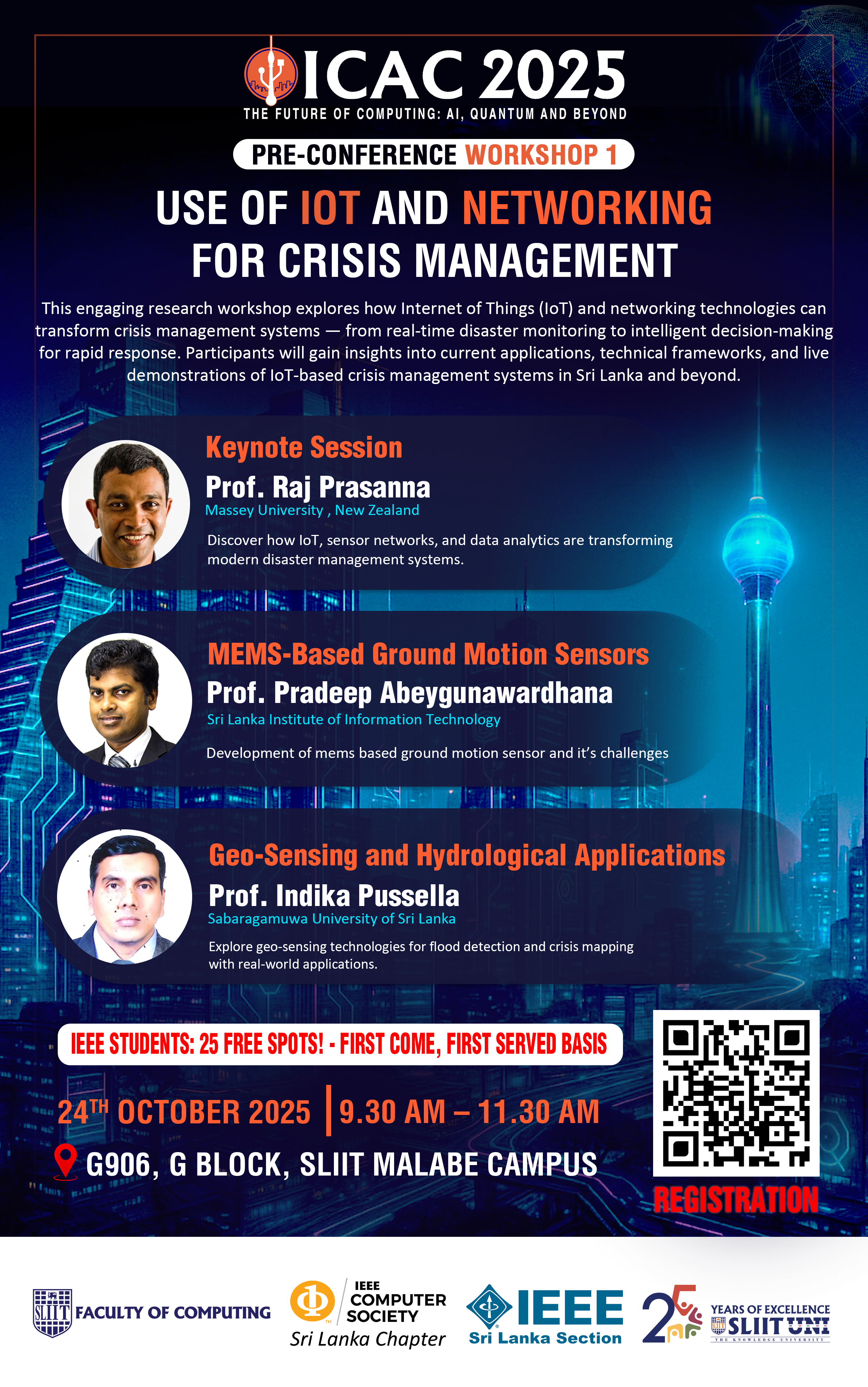
Use of IoT and Networking for Crisis Management
Workshop 1: Use of IoT and Networking for Crisis Management
Resource Persons:
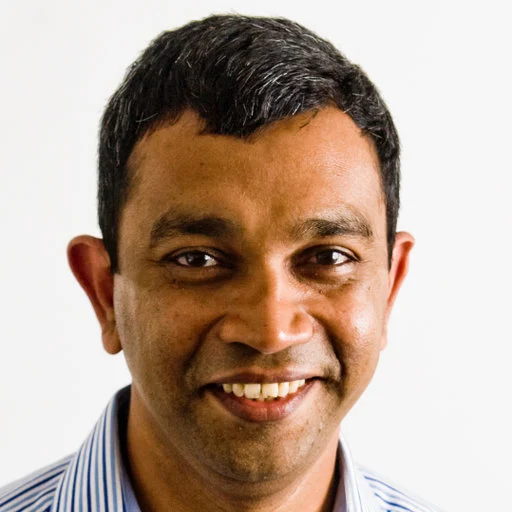
Deputy Director (Teaching) / Associate Professor, Massey University, New Zealand
View Profile
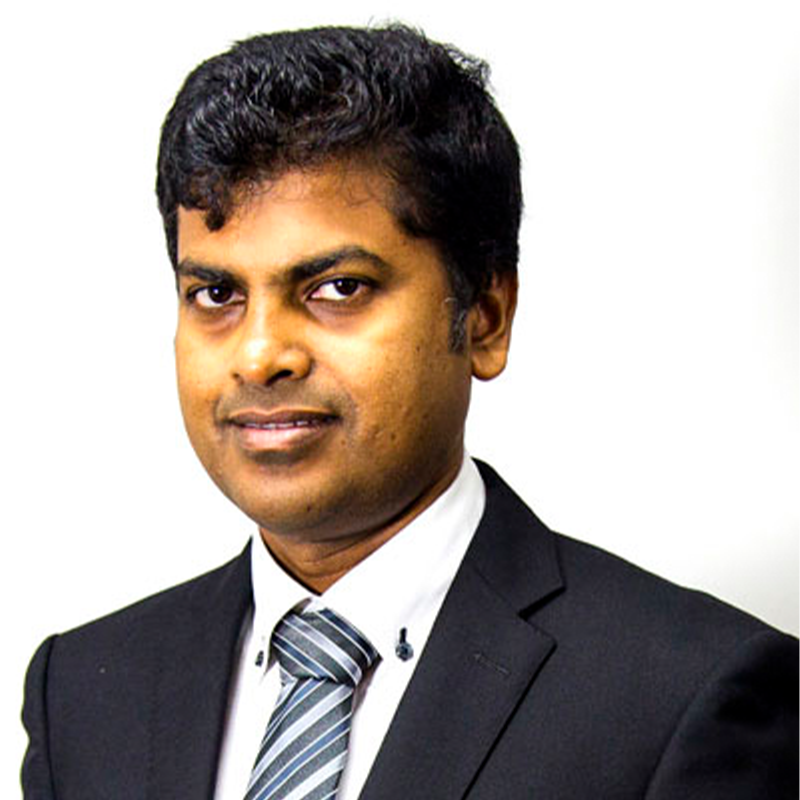
Dean, Faculty of Computing, Sri Lanka Institute of Information Technology
View Profile
Workshop Overview:
This engaging research workshop explores how Internet of Things (IoT) and networking technologies can transform crisis management systems — from real-time disaster monitoring to intelligent decision-making for rapid response. Participants will gain insights into current applications, technical frameworks, and live demonstrations of IoT-based crisis management systems in Sri Lanka and beyond.
Session Line-Up:
- Keynote Session by Prof. Raj Prasanna:
An internationally recognized expert in crisis informatics, Prof. Prasanna will discuss how IoT, sensor networks, and data analytics are integrated into modern disaster management systems.
- MEMS-Based Ground Motion Sensors by Prof. Pradeep Abeygunawardhana:
A distinguished researcher and academic in computer systems engineering with expertise in robotics, IoT, and intelligent systems, he will share insights on the development of MEMS-based ground motion sensors and their role in modern sensing technologies.
- Geo-Sensing & Hydrological Applications by Prof. Indika Pussalla:
A distinguished academic and researcher in geomatics and disaster management with expertise in GIS and remote sensing, he will share insights on geo-sensing technologies for flood detection and spatial crisis mapping.
- IEEE Computer Society Sri Lanka Chapter
Registration Deadline 22nd of October
Advancing Security in Distributed Systems through Confidential Federated Computing
Workshop 2: Advancing Security in Distributed Systems through Confidential Federated Computing
Resource Person:

About the Speaker:
Dr. K.P.N. Jayasena is an accomplished researcher and academic specializing in Confidential Computing, Cloud Security, Distributed Systems, and Networking. Currently serving as a Postdoctoral Research Fellow at TU Dresden's Faculty of Computer Science, Germany, she brings over twelve years of expertise in advancing security and reliability in distributed computing environments.
Her research portfolio includes contributions to several EU-funded initiatives, notably the Horizon Europe NEARDATA project on extreme near-data processing platforms. Prior to her current role, she served as a Senior Lecturer at Sabaragamuwa University of Sri Lanka for over a decade, teaching courses on cloud computing, distributed systems, and software quality assurance.
Dr. Jayasena earned her Doctor of Engineering in Computer Science from Wuhan University of Technology, China, focusing on meta-heuristic resource scheduling in cloud environments. Her research has appeared in top-tier Q1 journals and CORE-ranked international conferences. She has received multiple accolades including the President's Award for Scientific Research (2023) from Sri Lanka's National Research Council and numerous IEEE Best Paper Awards. As a leader within IEEE, she has served as Conference Chair, TPC Chair, and Secretary of the IEEE Computer Society Sri Lanka Chapter, and as an Executive Member of IEEE Women in Engineering.
Session Overview:
Confidential Federated Computing combines federated learning with hardware-based security to address privacy challenges in distributed systems. Instead of centralizing sensitive data, this approach enables collaborative computation across decentralized data sources while keeping data at its origin.
By integrating Confidential Computing technologies like Trusted Execution Environments (TEEs), data remains protected not only during storage and transmission but also during processing. Hardware-enforced encryption—implemented through technologies such as Intel SGX, AMD SEV, and ARM TrustZone—creates isolated secure enclaves for encrypted computation. This shields against insider threats and external attacks, maintaining confidentiality even from system administrators.
Applications include secure medical model training across hospitals, collaborative fraud detection between financial institutions, and privacy-preserving IoT analytics. With rising global emphasis on data privacy and regulatory compliance, Confidential Federated Computing offers a scalable and trustworthy framework for secure, distributed AI.
Registration Deadline 6th of November
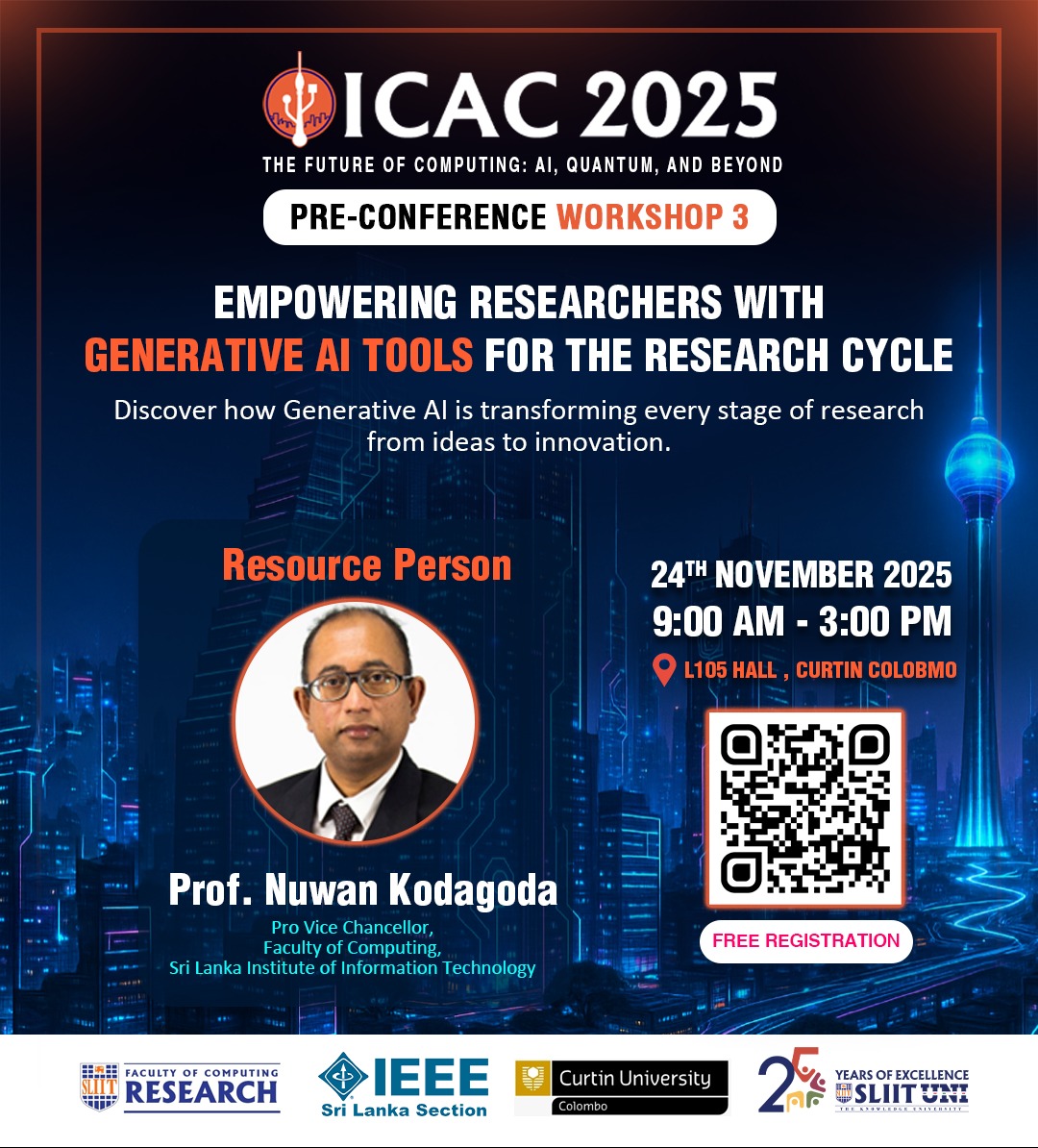
Empowering Researchers with Generative AI Tools for the Research Cycle
Workshop 3: Empowering Researchers with Generative AI Tools for the Research Cycle
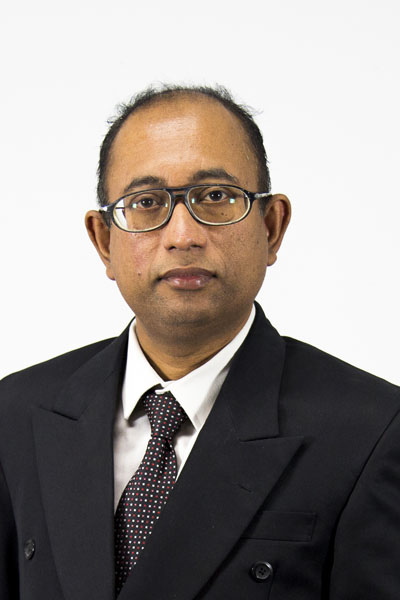
Resource Person:
Workshop Overview:
Artificial Intelligence (AI) — and particularly Generative AI (GenAI) — is rapidly reshaping how research is conceived, conducted, and communicated. From literature reviews and data analysis to writing and visualization, AI now offers powerful new methods to accelerate discovery and enhance productivity.
Objectives:
- Introduce participants to practical AI tools that support each phase of the research process.
- Build hands-on experience in using GenAI for ideation, synthesis, and research writing.
- Demonstrate how agentic AI systems can autonomously assist in complex research tasks.
- Encourage responsible and ethical adoption of AI in research.
- Strengthen collaboration between Curtin and SLIIT academic and research communities.
Registration Deadline 21st November
Harnessing Text Analytics for User-Generated Content Analysis
Workshop 4: Harnessing Text Analytics for User-Generated Content Analysis
Resource Persons:



Workshop Overview:
Social media has become a central platform for communication, public discourse, and information exchange. With the growing volume of user-generated content, there is increasing academic and practical interest in analyzing social media text to understand trends, sentiments, behaviors, and opinions. This workshop is designed to provide university students and researchers with a comprehensive introduction to the field of social media text analysis.
Participants will explore the core concepts and analytical frameworks that underpin the study of textual data from social platforms. The session will cover methods for collecting and preparing social media data, techniques for text mining and classification, and practical applications such as sentiment analysis and topic modeling. In addition, participants will gain exposure to real-world use cases across academic and industry contexts, helping them understand how text analysis can inform research, policy, and decision-making.
Through a combination of lectures and hands-on exercises, attendees will develop practical skills in working with social media data using current tools and methodologies. The workshop aims to equip participants with the foundational knowledge and technical competence needed to carry out their own text analysis projects.
This workshop will serve as an introductory exploration of the process involved in detecting text analysis on social media platforms. It is particularly suited for university students and researchers engaged in related fields.
Objectives:
- Introduce foundational concepts in social media text analysis, including key terminology and analytical frameworks.
- Explore real-world applications of social media text analysis in various research and industry contexts.
- Allow the participants to understand the ongoing research related to social media text analysis.
- Develop practical skills through hands-on exercises focused on text mining, sentiment analysis, topic modeling, and text classification using social media data.
Registration Link
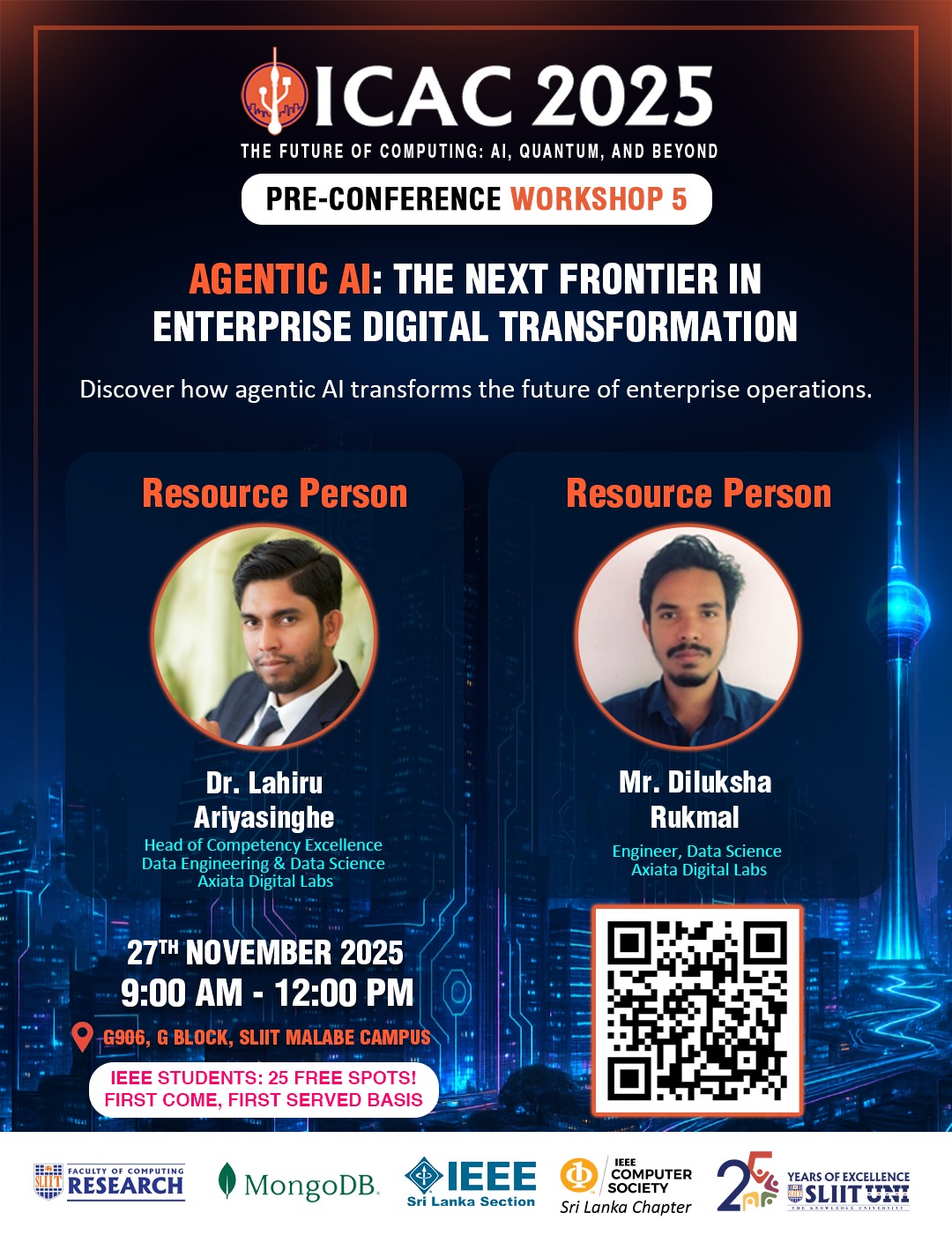
Agentic AI – The Next Frontier in Enterprise Digital Transformation
Workshop 5: Agentic AI: The Next Frontier in Enterprise Digital Transformation
Resource Persons:


Bio – Dr. Lahiru Ariyasinghe:
Dr. Lahiru has a diverse background in software development for research and commercial purposes, teaching computer science at the university level, and conducting original research in computer systems. With over 12 years of experience, he has held various positions, including Lecturer, Research Scholar, Research Software Engineer (RSE), and founding tech startups in Sri Lanka and New Zealand. His main areas of interest are Data Science, Distributed Systems & Security. He has previously worked on Web Caching, Content Delivery Networks, OTT Video Delivery, and Network Resource Management. Being a dual scholarship holder, he obtained his Ph.D. in Computer Science from the University of Otago, New Zealand, and a BSc (Hons) in IT with First Class from the Sri Lanka Institute of Information Technology (SLIIT). Currently, Dr. Lahiru is the Head of Competency Excellence – Data Engineering & Data Science at Axiata Digital Labs (ADL).
Bio – Diluksha Rukmal:
Diluksha Rukmal is a Data Science Engineer specializing in GenAI, large language models, Agentic AI, and fine-tuning small language models. With hands-on experience in building AI agents and integrating AI-driven workflows, he focuses on developing Agentic AI architectures that bring autonomy and reasoning to enterprise applications. Passionate about exploring the frontier of intelligent systems, he aims to design more practical, reliable, and human-aligned AI applications.
Abstract:
The emergence of Agentic AI marks a pivotal evolution in enterprise digital transformation—moving beyond traditional automation toward systems that can reason, plan, and act autonomously across business ecosystems. By combining the intelligence of language models with decision-making frameworks and multi-agent orchestration, Agentic AI enables organizations to achieve adaptive, goal-driven operations that continuously learn and optimize outcomes. This paradigm empowers enterprises to integrate autonomous agents into domains such as IT operations, customer experience, supply chain, and governance—driving exponential gains in agility, efficiency, and innovation. As the next frontier in digital transformation, Agentic AI redefines how enterprises design workflows, interact with data, and realize strategic intent through intelligent, self-evolving systems.
Registration Link
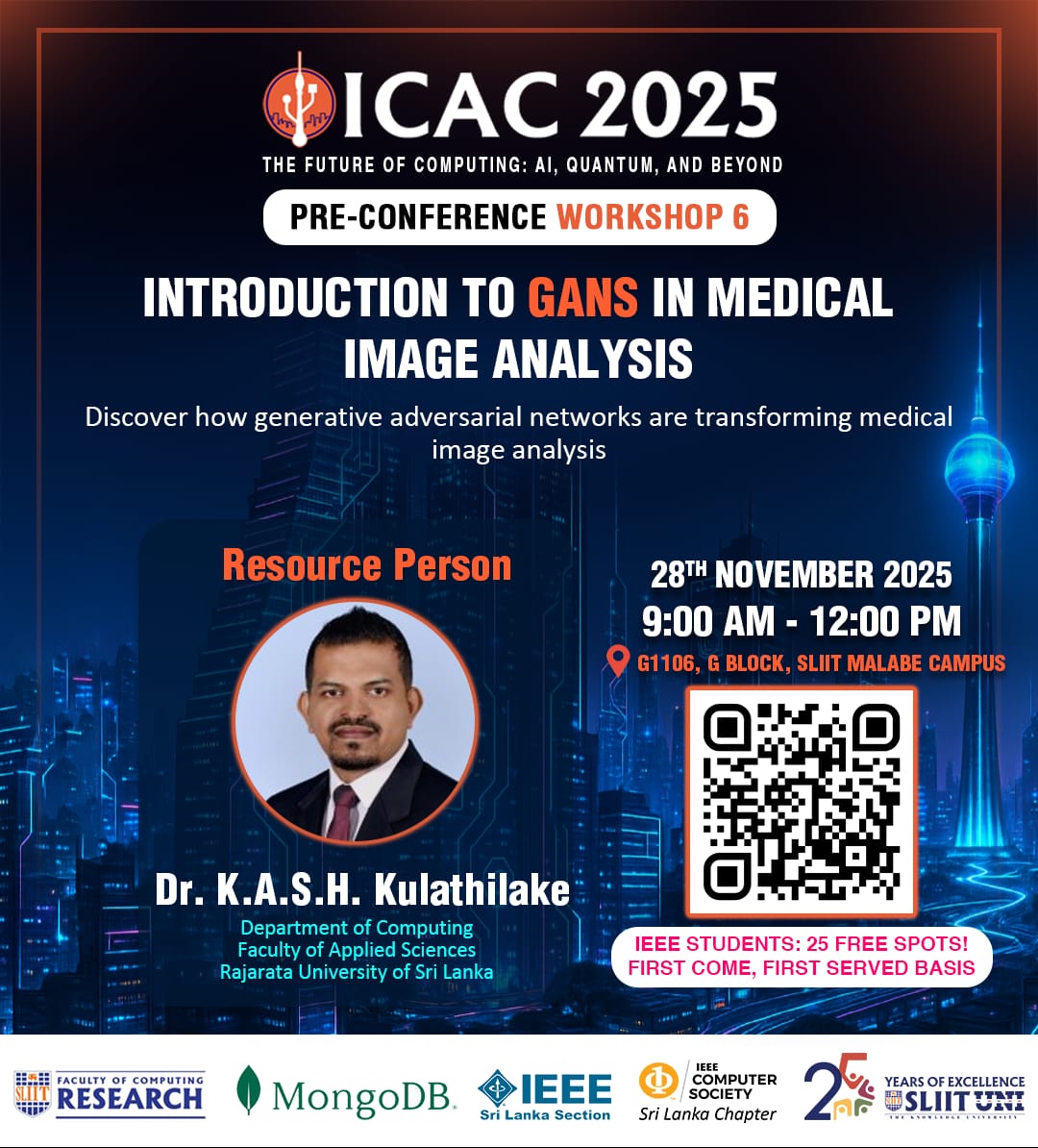
Introduction to GANs in Medical Image Analysis
Workshop 6: Introduction to GANs in Medical Image Analysis
Resource Persons:

Workshop Overview:
This workshop offers an entry point into the transformative role of Generative Adversarial Networks (GANs) in medical image analysis. Designed for researchers, practitioners, and students with an interest in AI and biomedical imaging, the session will explore both foundational knowledge and real-world applications of GANs in healthcare.
Objectives:
- Introduce the fundamental concepts of GANs and their working mechanism.
- Examine the relevance of medical imaging in the modern healthcare landscape.
- Demonstrate how GANs contribute to denoising, augmentation, segmentation, and restoration of medical images.
- Provide hands-on experience using Python-based tools and medical imaging datasets.
- Facilitate critical discussions on ethical concerns and limitations in applying GANs in clinical contexts.
GenAI in Research
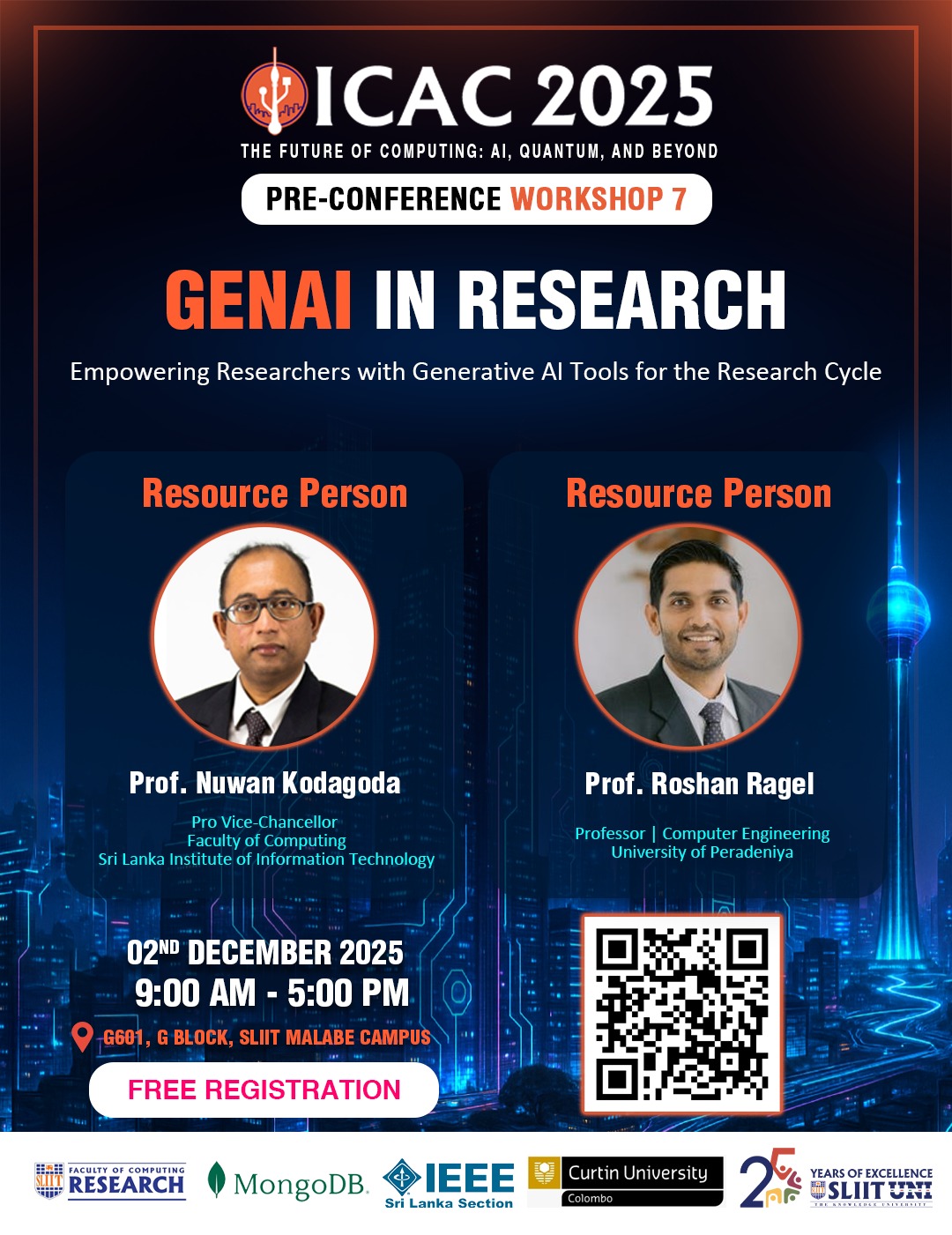
Workshop 7: GenAI in Research
Resource Persons:

📍 G601, SLIIT Malabe Campus
📍 G602, SLIIT Malabe Campus
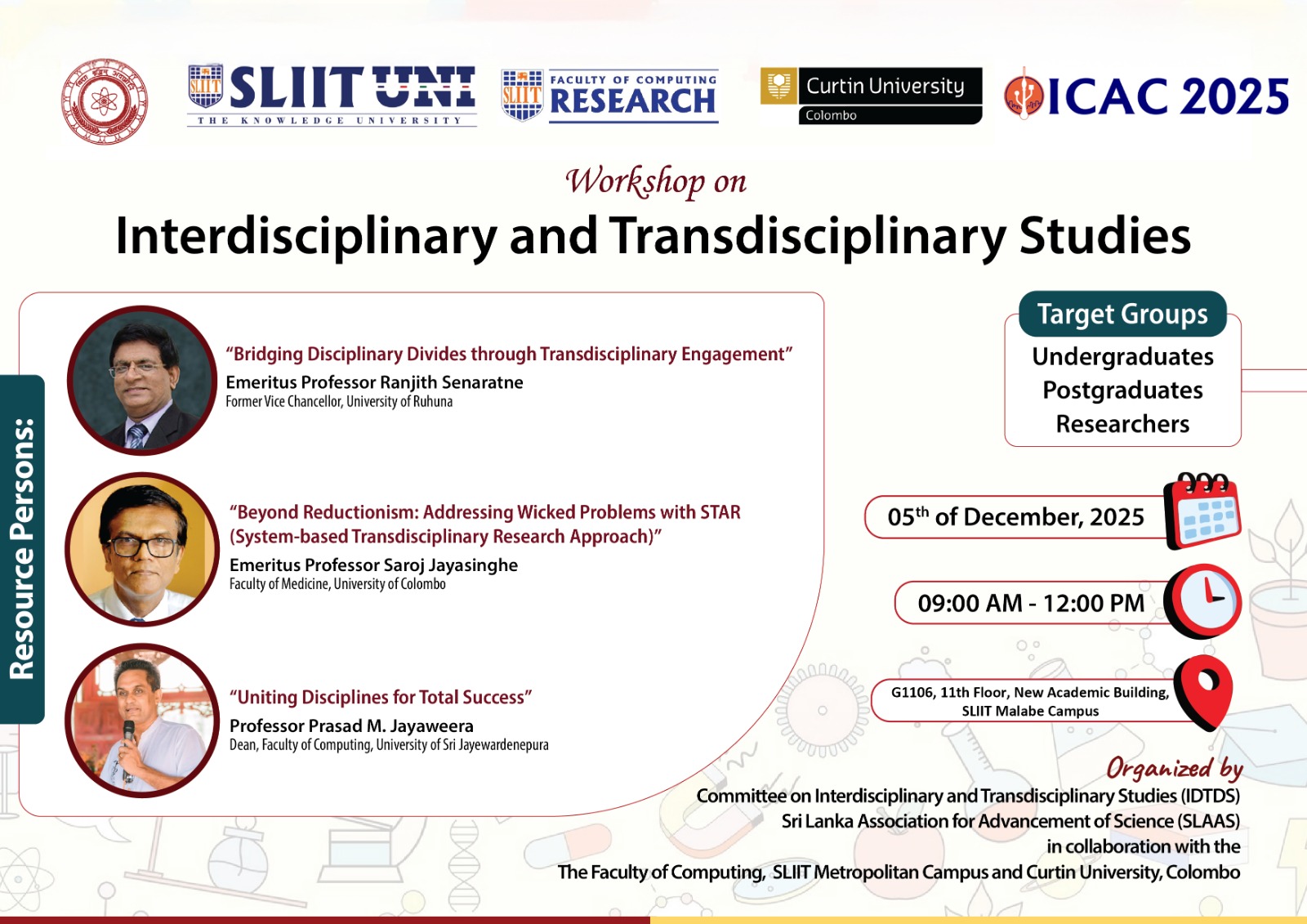
Interdisciplinary and Transdisciplinary Studies
Workshop 8: Interdisciplinary and Transdisciplinary Studies
Resource Persons:
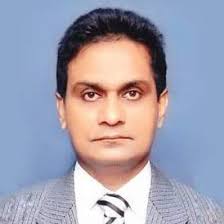
Dean, Faculty of Computing, University of Sri Jayewardenepura
View Profile
MongoDB Educator Training
Workshop 9: MongoDB Educator Training